Blog
GM 6.2 Recall—Complete 6.2L V8 Engine Crisis Owner’s Guide

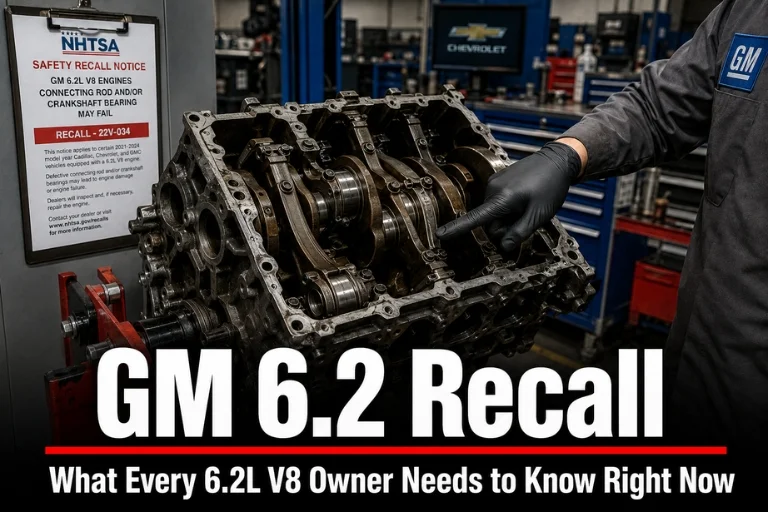
If you own a 2021 through 2024 Chevrolet Silverado, GMC Sierra, Chevrolet Tahoe, Chevrolet Suburban, GMC Yukon, Cadillac Escalade, or any other full-size GM truck or SUV equipped with the 6.2L V8 engine, this article is one of the most important things you will read as a vehicle owner. In April 2025, General Motors issued a landmark safety recall — NHTSA Campaign 25V-274 — covering approximately 597,630 to 721,000 vehicles equipped with the L87 6.2L V8 engine manufactured between March 2021 and May 2024. The GM 6.2 recall stems from serious manufacturing defects in engine connecting rod and crankshaft components that can cause complete engine failure—in some cases while the vehicle is traveling at highway speeds. This complete guide explains exactly what the 6.2 recall covers, what caused the defect, which vehicles are affected, what the fix involves, and what every owner needs to do right now.
What Is the GM 6.2 Recall? — The Full Background
The GM 6.2 recall is formally documented under NHTSA Campaign 25V-274, issued by General Motors in April 2025 following years of growing internal evidence of a serious manufacturing quality failure within the L87 6.2L V8 engine production process.
The 6.2 Chevy engine—officially designated RPO L87—is one of General Motors’ flagship powerplants, serving as the top-tier engine option across the entire GM full-size truck and SUV lineup. It powers the premium trim levels of the Chevrolet Silverado 1500, GMC Sierra 1500, Chevrolet Tahoe and Suburban, GMC Yukon and Yukon XL, and the Cadillac Escalade and Escalade ESV—making it one of the most widely installed high-performance V8 engines in the American market.
The 6.2L V8 is also featured as the standard engine in one of the most sought-after luxury SUVs in the country—the 2017 GMC Yukon Denali—making it important to note that while the 2017 GMC Yukon Denali predates the specific recall window of 2021 to 2024, the underlying performance reputation of the 6.2L V8 engine family and the structural knowledge gained from the recall investigation have significant implications for owners of older 6.2-equipped vehicles as well.
What makes the GM 6.2 engine recall particularly significant—and concerning—is not just the scale of vehicles affected but the timeline of how GM handled knowledge of the problem before issuing the recall. Internal GM records show that the company opened and closed three separate internal investigations into 6.2L V8 engine failures in February 2022, June 2023, and July 2024—and took no formal corrective action on any of them. It was not until the National Highway Traffic Safety Administration opened its own investigation in January 2025 after receiving approximately 350 consumer complaints that GM finally moved to formally acknowledge the defect and issue a recall.
By the time the recall was issued, GM’s own internal records documented 28,102 engine failure reports received between April 2021 and February 2025, with approximately half of those failures occurring while the vehicle was actively in operation on the road. The NHTSA confirmed at least 12 crashes and 12 injuries directly attributable to these defects.
What Caused the 6.2L GM Recall Defect?
The technical root cause of the GM 6.2 recall involves two simultaneous manufacturing quality failures that affected engines produced between March 2021 and May 2024.
Defect 1 — Machining Sediment Contamination
During the manufacturing process of the connecting rod bearings, machining sediment—fine metallic debris generated during the precision cutting and finishing of the rod bearing surfaces—contaminated internal oil passages within the connecting rods and crankcase oil galleries. This sediment restricted or blocked the flow of pressurized engine oil to the rod bearings, starving them of lubrication and causing accelerated wear and early bearing failure. In severe cases, bearing failure progressed to catastrophic connecting rod failure—a condition that can cause immediate, complete engine destruction.
Defect 2 — Out-of-Specification Crankshaft Dimensions
Simultaneously, certain crankshaft components within the affected production window exhibited dimensional inaccuracies and surface finish irregularities that fell outside the manufacturing tolerances required for reliable long-term operation. These out-of-spec crankshaft surfaces increased wear rates on the rod bearing journals at a pace significantly faster than a properly manufactured crankshaft would experience, compounding the damage from the oil passage contamination described above.
The combination of these two simultaneous failures — restricted oil flow to bearings already experiencing accelerated wear from dimensional defects — created a failure mode that could develop progressively over thousands of miles before culminating in sudden, complete engine failure. Dealers were instructed to scan affected vehicles for diagnostic trouble code P0016, which indicates a crankshaft-to-camshaft synchronization fault — one of the detectable signals that the engine’s internal rotating assembly has been compromised.
Which Vehicles Are Affected by the 6.2 Recall?
The GM 6.2 recall—NHTSA Campaign 25V-274—covers all of the following vehicles equipped with the L87 6.2L V8 engine and manufactured between March 1, 2021 and May 31, 2024:
- Chevrolet Silverado 1500—2021 through 2024 model years with 6.2L V8 option
- GMC Sierra 1500—2021 through 2024 model years with 6.2L V8 option
- Chevrolet Tahoe—2021 through 2024 model years with 6.2L V8 option
- Chevrolet Suburban—2021 through 2024 model years with 6.2L V8 option
- GMC Yukon and Yukon XL — 2021 through 2024 model years with 6.2L V8
- Cadillac Escalade — 2021 through 2024 model years
- Cadillac Escalade ESV — 2021 through 2024 model years
It is important to note that the 6.2L recall does not affect 2025 model year vehicles. GM confirmed to regulators that a series of crankshaft and connecting rod manufacturing improvements implemented on or before June 1, 2024, addressed the contamination and dimensional quality issues responsible for the failures. All 2025 model year production incorporated these improvements and is therefore outside the recall scope. The recall also does not affect any vehicles equipped with the 5.3L V8 or any other engine type—only the 6.2L L87 V8 in the specified model year and production date range is covered.
A secondary NHTSA investigation expanded scrutiny to an additional 286,000 GM trucks and SUVs from model years 2019 through 2024 after further reports of similar engine problems emerged in vehicles outside the original recall window. This expanded investigation covers 2019 and 2020 Chevrolet Silverado 1500 and GMC Sierra 1500 models as well, though these were not formally included in the original April 2025 recall campaign.
The 6.2 Chevy Engine—Performance Legacy and Why the Recall Matters
To fully understand why the 6.2 Chevy engine recall generated such significant concern among owners, buyers, and the broader automotive community, it is important to recognize what the L87 6.2 L V8 represents in the GM lineup.
The 6.2L V8 is not a basic economy engine — it is GM’s flagship naturally aspirated V8, producing 420 horsepower and 460 lb-ft of torque in its standard full-size truck application. It powers the premium trim levels of GM’s most important and highest-revenue vehicles, including the Denali trim of the GMC Sierra and Yukon, the High Country trim of the Silverado, and every Cadillac Escalade built during the recall period. Buyers of these vehicles paid premium prices specifically because of the additional performance, towing capability, and prestige associated with the 6.2L V8 option.
The 2017 GMC Yukon Denali, while predating the specific 2021 to 2024 recall window, benefited from the same L87 engine architecture and established the performance baseline that the recalled 2021 to 2024 units were meant to uphold. The recall does not cover the 2017 GMC Yukon Denali, but owners of that model year and surrounding years should be aware that the recall investigation has focused significant engineering attention on this engine family’s bearing and crankshaft specifications.
Understanding the full specification and performance history of the 6.2L V8 in the context of GM’s broader LS and LT engine family provides essential context for evaluating replacement options.
What Warning Signs Should 6.2L V8 Owners Watch For?
GM’s own Part 573 recall filing described the progressive symptoms that can appear before engine failure in affected vehicles. Every owner of a 2021 to 2024 vehicle with the 6.2L V8 should know these warning signs:
Unusual Engine Noises
A knocking, ticking, or rattling sound from the engine bay—particularly one that is worse immediately after a cold start or intensifies under load—is one of the earliest audible indicators of developing rod bearing failure. Do not dismiss unusual engine noises as normal break-in sounds in a relatively new vehicle.
Check Engine Light
The P0016 diagnostic trouble code—indicating a crankshaft-to-camshaft synchronization fault—was specifically identified in the recall documentation as a detectable precursor to engine failure in affected vehicles. Any check engine light on a recalled vehicle should be scanned immediately at a dealership.
Loss of Power or Hesitation
Unexplained power reduction, hesitation under acceleration, or a general feeling that the engine is not performing at its expected level can indicate developing internal damage from bearing wear or oil flow restriction.
Abnormal Shifting or Reduced Propulsion
Owners reported abnormal transmission shifting behavior and reduced propulsion in vehicles approaching engine failure—symptoms that can be confused with transmission problems but actually originate from the engine’s deteriorating internal condition.
No-Start Condition
In the most severe cases, affected vehicles experienced sudden no-start conditions following progressive internal engine damage that the driver had no warning of before the failure became complete.
What Is the Official Fix for the GM 6.2 Recall?
General Motors directed dealers to perform a two-stage inspection and repair procedure for all vehicles covered under Recall 25V-274.
Stage 1 — Diagnostic Inspection
Dealers scan the affected vehicle’s ECM for the presence of diagnostic trouble code P0016. Vehicles that do not trigger this code are considered to have passed the initial inspection.
Stage 2A — Pass Result
Vehicles that pass the P0016 inspection receive an oil specification update—transitioning the vehicle from its original factory 0W-20 oil specification to a higher-viscosity 0W-40 oil, which provides improved bearing lubrication film thickness at operating temperature. A new oil fill cap and a revised owner’s manual insert documenting the new oil specification are also provided. An oil change is performed during this service.
Stage 2B — Fail Result or Active Symptoms
Vehicles that fail the P0016 inspection, or those presenting active engine damage symptoms, are eligible for complete engine replacement at no cost to the owner under the recall.
However, a significant and ongoing concern for affected owners is that the prescribed recall fix has not been universally effective. As of early 2026, federal safety regulators had received 36 Vehicle Owner Questionnaires alleging engine failure in vehicles where the recall fix had already been completed—meaning the oil viscosity change alone did not prevent further engine failures in some cases. This development has prompted renewed regulatory scrutiny of GM’s remedy and the question of whether additional corrective action beyond the initial recall fix is necessary.
The 6.2 Recall and Class Action Lawsuits
The GM 6.2 recall has triggered significant legal activity. Multiple individual lawsuits from truck and SUV owners alleging that GM knew about the defect years before taking action have been consolidated into a single federal class action case. The core allegation in these lawsuits is that GM’s three prior internal investigations — closed without corrective action in 2022, 2023, and 2024 — constitute documented evidence that GM had knowledge of the defect and its real-world consequences and chose not to act until regulatory pressure forced the company’s hand.
The class action specifically alleges that affected vehicle owners suffered economic harm through unexpected engine failures, diminished resale value of their vehicles due to the recall, and loss of use during extended repair periods at dealerships. Owners who experienced engine failure before the recall was issued — and who paid out-of-pocket for repairs — are a central focus of the litigation, seeking reimbursement for repair costs that GM’s delayed recall decision forced them to absorb independently.
What Should Affected Owners Do Right Now?
If you own a 2021 through 2024 GM vehicle equipped with the 6.2L V8 engine, these are the immediate action steps every owner should take:
Step 1 — Check Your VIN
Visit the NHTSA website at nhtsa.gov and enter your Vehicle Identification Number to confirm whether your specific vehicle is covered under Recall 25V-274. You can also call your GM dealership directly with your VIN for confirmation.
Step 2 — Schedule Your Recall Service Appointment Immediately
If your VIN is confirmed as affected, contact your nearest GM dealership to schedule the recall inspection and repair. This service is performed at no cost to the vehicle owner.
Step 3 — Document All Symptoms
If your vehicle has already exhibited any of the warning symptoms described in this article—unusual noises, check engine light, power loss, or abnormal shifting—document these symptoms with dates, mileage, and descriptions before your dealership appointment. This documentation supports your case if engine replacement rather than the basic oil update is warranted.
Step 4 — Know Your Rights
If you experienced engine failure before the recall was announced and paid for repairs out of pocket, contact GM’s customer service directly to request reimbursement. If GM declines, consult with a consumer protection or lemon law attorney about your options under the class action litigation.
Step 5 — Consider Your Options if Repair Fails Again
Given the documented cases of engine failure occurring after the recall fix was applied, owners whose engines fail again after the recall service should return to the dealership immediately and escalate to a complete engine replacement request if the initial fix has proven ineffective.
Replacement Engine Options for Affected Owners
For owners who have experienced complete engine failure and are weighing their options—whether warranty replacement, out-of-pocket dealer repair, or independent shop service—understanding the quality used engine market is an important part of the decision.
A high-quality used or remanufactured L87 6.2L V8 replacement can represent a cost-effective and reliable solution, particularly for vehicles approaching the end of their warranty period or for owners who prefer to use an independent shop rather than wait through extended dealership repair backlogs.
Conclusion
The GM 6.2 recall — NHTSA Campaign 25V-274 — is one of the most significant automotive safety events in GM’s recent history, covering up to 721,000 vehicles and representing years of delayed action on a documented manufacturing defect. The 6.2L GM recall stems from two simultaneous manufacturing failures in the L87 engine’s connecting rod and crankshaft components that can produce complete engine failure while driving. The 6.2 Chevy engine—long considered one of GM’s most prestigious power plants—now carries a recall that every 2021 to 2024 owner of an affected vehicle must take seriously and act on immediately.
If your vehicle is covered by this recall, check your VIN today, schedule your dealership inspection, document any symptoms you have experienced, and know your legal rights. Whether GM’s prescribed fix proves sufficient or your vehicle ultimately requires a complete engine replacement, informed action protects both your safety and your investment. For additional guidance on GM engine options and specifications, explore our complete LS engine specs and performance guide alongside our used engine price guide by car type to understand fair market values for replacement components.
Frequently Asked Questions
Q1. What is the GM 6.2 recall?
The GM 6.2 recall—formally NHTSA Campaign 25V-274—is a safety recall issued by General Motors in April 2025 covering approximately 597,630 to 721,000 vehicles equipped with the L87 6.2L V8 engine manufactured between March 2021 and May 2024. The recall addresses manufacturing defects in connecting rod and crankshaft components that can cause engine failure, including while the vehicle is being driven.
Q2. What is the 6.2L GM recall defect exactly?
The 6.2L GM recall involves two simultaneous manufacturing defects: machining sediment that contaminated oil passages in the connecting rods and crankcase galleries, restricting lubrication to rod bearings, and dimensional inaccuracies and surface finish irregularities in crankshaft components that accelerated bearing wear rates. Together these defects cause premature engine failure.
Q3. Is the 2017 GMC Yukon Denali affected by the GM 6.2 recall?
No. The 2017 GMC Yukon Denali predates the specific recall window. The GM 6.2 recall covers vehicles manufactured between March 1, 2021 and May 31, 2024. The 2017 GMC Yukon Denali and other pre-2021 models equipped with the 6.2L V8 are not included in Recall 25V-274, though NHTSA has opened a separate expanded investigation covering some 2019 and 2020 models.
Q4. Does the 6.2 recall affect the 6.2 Chevy engine in all trims?
The 6.2 recall affects all vehicles within the specified model year and build date window that are equipped with the L87 6.2L V8 engine, regardless of trim level. However, not every trim level of each affected vehicle was available with the 6.2L engine—in models where it was an optional upgrade rather than the standard engine, only those specific vehicles with the 6.2L option are covered.
Q5. What is the fix for the 6.2 recall?
Dealers inspect affected vehicles for diagnostic trouble code P0016. Vehicles passing inspection receive an oil specification change from 0W-20 to higher-viscosity 0W-40 oil, a new oil fill cap, and a revised owner’s manual. Vehicles failing inspection or showing active engine damage symptoms are eligible for complete engine replacement at no cost to the owner under the recall.
Q6. Why does the 6.2 recall not cover 2025 vehicles?
GM confirmed to regulators that manufacturing improvements to the crankshaft and connecting rod production processes implemented on or before June 1, 2024, resolved the contamination and dimensional quality issues responsible for the defect. All 2025 model year vehicles were produced after these improvements and are not affected by the 6.2 recall.
Q7. What should I do if my engine failed after the 6.2 recall fix was already done?
If your engine failed after the recall repair was completed, return to the dealership immediately and document the failure in writing. Escalate to a complete engine replacement request, as the oil specification update alone has not been effective in all cases. If the dealership does not resolve the issue satisfactorily, contact GM’s customer service and consult with a lemon law attorney about your rights under the class action litigation.